
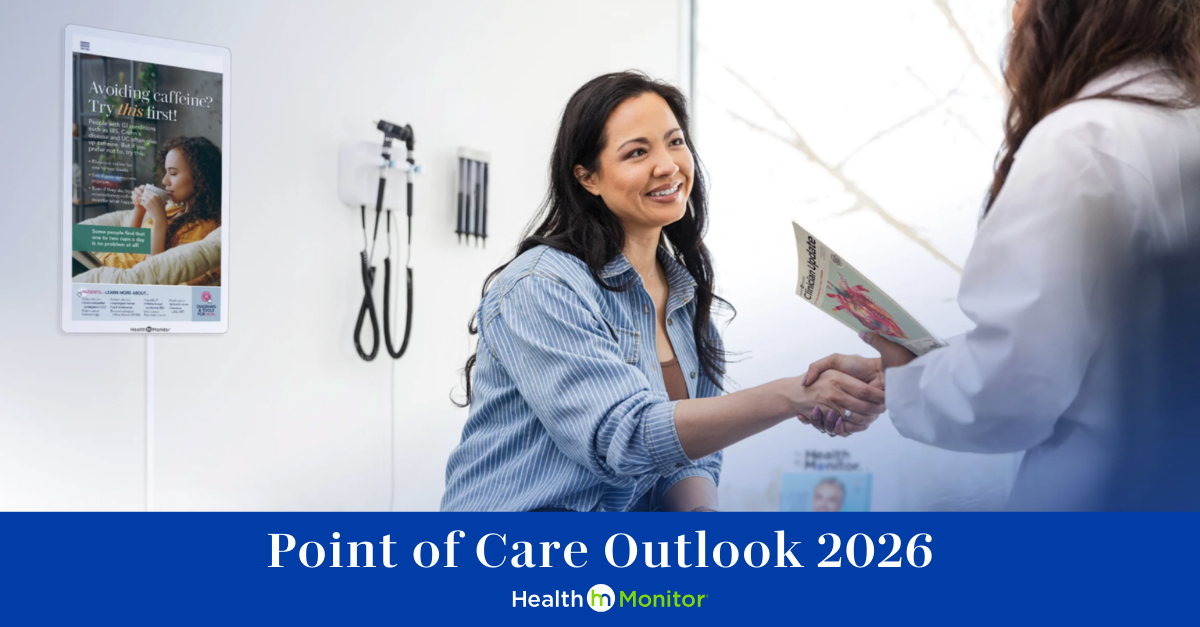
The Channel Redefining Healthcare Engagement
The point of care is where healthcare becomes real. It is the moment when questions surface, decisions crystallize and care moves forward. In 2026, this moment is no longer just clinical—it is redefining how healthcare marketing works.
Point of Care (POC) Marketing has emerged as one of the most influential environments for trusted information and meaningful engagement. Embedded directly within clinical workflows, POC naturally aligns with how clinicians practice and how patients experience care. For healthcare marketers, success now hinges on designing for this moment with relevance, responsibility and respect for the care setting. Those who do will see stronger outcomes, deeper trust and more accountable impact.
The Market Has Validated Point of Care Marketing
The growth of POC marketing is no longer theoretical—it is proven by sustained investment and expanding adoption across healthcare settings.
Recent industry analyses show that POC marketing investment has accelerated dramatically. According to the Point of Care Marketing Association (POCMA), reported POC marketing spend among member organizations increased 171% between 2019 and 2023.1 In 2024, the industry surpassed $1 billion in revenue, according to POCMA member data.1, 2
Equally telling is where that growth is coming from. POC expansion has coincided with softening investment in certain traditional HCP advertising channels.1, 3 This signals a strategic reallocation of healthcare marketing budgets toward environments that more closely align with clinical decision-making moments and patient engagement during active care delivery.
In short, marketers are no longer chasing attention wherever it can be found—they are prioritizing relevance where it matters most.
The Point of Care is Where Decisions Take Shape
By definition, the point of care represents the clinical moment when decisions are actively being made. Clinicians evaluate treatment options, consider evidence and apply guidelines. Patients absorb information, ask questions and form intent in real time.
These moments occur across diverse care settings—exam rooms, infusion centers, pharmacies and specialty clinics—but they share a common characteristic: attention is focused and health concerns are immediate.
Delivering relevant, trusted information at the point of care enhances both education and action. Unlike media encountered outside the clinical environment, POC content is experienced when it can directly influence patient-provider conversations and support informed decision-making.
Increasingly, industry guidance recognizes POC as one of the most effective settings for reinforcing clinical understanding and enabling shared decisions. 4, 6
Trust and Context Matter More Than Ever
Healthcare professionals and patients alike are navigating an unprecedented volume of information.
Research from physician organizations and healthcare publications highlights time pressure, workflow constraints and systemic burdens as defining realities of modern care delivery.⁵ In this environment, context is not a luxury—it is essential.
POC channels benefit from inherent credibility because they are embedded within clinical settings and designed to align with care delivery.⁶ When executed thoughtfully, POC content feels less like advertising and more like support.
As a result, it is more likely to be perceived as relevant, credible and appropriate than messaging encountered in non-clinical contexts.
Trust at the point of care is earned through alignment with the moment—not through volume or repetition.
From Awareness to Accountability
As healthcare marketing continues to evolve, brands are increasingly evaluated not just on reach, but on their ability to demonstrate meaningful outcomes.
Industry analyses point to a clear shift away from awareness-only metrics toward optimization, performance and measurable engagement.³
POC marketing aligns naturally with this shift.
When integrated early into omnichannel planning, POC reinforces messaging at critical decision moments, strengthening the effectiveness of digital, field and educational efforts rather than competing with them.⁴
This integration transforms POC from a tactical placement into a strategic lever—one that supports accountability across the full patient and provider journey.
What 2026 Demands from Healthcare Brands
To succeed at the point of care in 2026, healthcare brands must rethink both strategy and execution. Leading approaches include:
- Embedding POC early in campaign planning, rather than treating it as a downstream add-on⁴
- Designing content specifically for clinical environments, supporting conversations instead of interrupting them⁶
- Balancing digital and in-office formats to reach both patients and clinicians across multiple moments of care⁴
These principles reflect a broader industry understanding: in healthcare, relevance and context consistently outperform scale alone.
Looking Ahead
Point of care has moved from the margins to the center of healthcare marketing strategy.1, 2
Its sustained investment growth, increasing accountability and direct alignment with real-world care delivery position POC as more than a media channel—it is a strategic environment where trust, education and influence intersect. 1, 3, 4
At Health Monitor Network, we view the point of care not simply as a place for messaging, but as a moment of responsibility. Brands that approach POC with intelligence, clinical awareness and respect for the care experience will be best positioned to drive meaningful engagement—and measurable impact—in the years ahead.
References
- Point of Care Marketing Association (POCMA). (2025). New report reveals point of care marketing spend surges 171% as healthcare marketing landscape transforms. PR Newswire. https://www.prnewswire.com/news-releases/new-report-reveals-point-of-care-marketing-spend-surges-171-as-healthcare-marketing-landscape-transforms-302423737.html
- Fierce Pharma. (2025). Point of Care Isn’t Optional. It’s the $1B Channel Redefining Success. https://www.fiercepharma.com/sponsored/point-care-isnt-optional-its-1b-channel-redefining-success
- MM+M (Medical Marketing & Media). (2025). Healthcare Marketers Trend Report 2025: Into the wind. https://www.mmm-online.com/features/healthcare-marketers-trend-report-2025-into-the-wind
- Point of Care Marketing Association. (2025). Top point of care marketing strategies for 2026.
https://pocmarketing.org/resources-insights/top-point-of-care-marketing-strategies-for-2026 - American Medical Association. (2025). Measuring and addressing physician burnout.
https://www.ama-assn.org/practice-management/physician-health/measuring-and-addressing-physician-burnout - Paubox. (2025). The role of point of care marketing in healthcare. https://www.paubox.com/blog/the-role-point-of-care-poc-marketing-in-healthcare
