
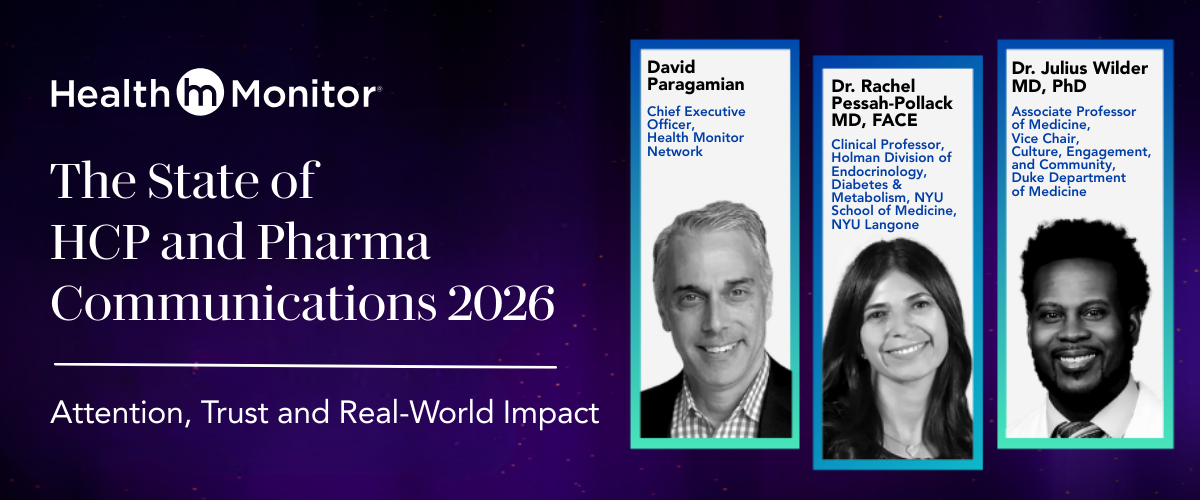
Attention, Trust and Real-World Impact
How healthcare communications can move from channel presence to practical value across the care journey.
Roundtable Participants
The following experts participated in the roundtable discussion that informed this whitepaper:
- David Paragamian, Chief Executive Officer, Health Monitor
- Rachel Pessah-Pollack, MD, FACE, Clinical Professor, Division of Endocrinology, Diabetes & Metabolism, NYU School of Medicine, NYU Langone Health
- Julius M. Wilder, MD, PhD, Associate Professor of Medicine; Vice Chair of Culture, Engagement, and Community; Duke Department of Medicine
- Fleur Lee, Senior Director of Marketing, Eisai
- Sarah Bast, EVP Investment Marketplace, Publicis Health Media
- Frank Biscardi, SVP, Point of Care Investment, Havas
Participants contributed their perspectives in a personal or professional capacity. Their inclusion does not constitute formal endorsement of this publication.
About this paper
This thought leadership paper is based on a Health Monitor roundtable with clinicians, brand leaders and agency partners exploring how HCP and patient communications are experienced across real care settings. It distills the discussion into a forward-looking point of view for pharmaceutical marketers, media strategists and healthcare partners.
Executive Summary
Healthcare communications do not have a reach problem. They have a relevance problem.
Brand messages now appear everywhere: on television, in exam rooms, waiting rooms, inboxes, conferences, digital platforms and the broader media environments where patients and clinicians encounter health information every day. Yet more presence has not translated into more impact. Attention remains limited. Trust must be earned. And effectiveness depends less on how often communications appear than on whether they are useful, credible and appropriate to the moment.
Health Monitor convened this discussion to better understand how marketing communications are actually experienced across real care settings. The conversation pointed to a new standard for success in 2026. Communications must do more than drive visibility—they must fit workflow, reflect context, reduce friction and support better decisions.
Three conclusions stood out.
First, the empowered patient is real, but imbalanced. Some patients now arrive with AI-generated summaries, online research and highly specific requests, while others still face barriers in health literacy, digital fluency and access to credible information.
Second, trust is increasingly shaped by authenticity. Clinicians are not rejecting engagement from industry; they are rejecting communication that feels generic, overly promotional or disconnected from the realities of practice.
Third, utility is becoming the defining standard for performance. In a crowded communications environment, the messages that break through are the ones that solve problems, answer questions, reduce barriers and help move care forward.
The implication is clear: the future of HCP and pharma communications belongs to organizations that can align message, environment and need. In 2026, real-world impact will depend on whether communications are designed not just to be seen, but to matter.
1. Empowered Patients Can Sometimes Be Misinformed
The conversation opened with a defining question from David Paragamian, CEO of Health Monitor: Do you believe that we’re living in the age of the empowered patient and the consumer?
The idea of the empowered patient has become central to healthcare marketing, but the roundtable revealed a more nuanced reality. More patients are arriving informed, engaged and prepared to ask questions. Some are researching treatment options online. Some are using generative AI tools to interpret labs, summarize symptoms or shape the language they bring into medical encounters. Many are more proactive than patients were even a few years ago.
But access to information is not the same as understanding. Participants described a growing gap between patients who are digitally fluent and highly activated, and those who remain limited by lower health literacy, lower digital confidence or reduced access to credible resources. Even among engaged patients, accuracy remains a challenge. Information may be incomplete, misleading, decontextualized or simply wrong.
That creates a new communications mandate. The goal isn’t just to educate; it is to help interpret. Effective communications must support understanding, enable more productive conversations between patients and clinicians, and close the gap between information access and evidence-based decision-making.
“Patients are coming in with all this information and not really knowing how to interpret it. Our role is to distill what is most important, clarify what warrants further investigation, and build trust by ensuring our perspective is rooted in evidence-based medicine.”
– Dr. Rachel Pessah-Pollack, Clinical Professor of Medicine, NYU
2. Attention Is Scarce – Relevance Wins
Paragamian continued the conversation asking: What healthcare communications truly create value for clinicians?
Healthcare professionals are surrounded by communication. Emails arrive at work and at home. Rep visits compete with packed schedules. Messages show up at conferences, in offices, through digital channels and across a growing number of care-adjacent platforms. Saturation is not the exception; it is the norm.
But saturation does not create engagement. What clinicians described was a simple filter: they pay attention when communication gives them something new, helps solve a real problem, or arrives in a setting that allows for substantive exchange. Protected environments like conferences can work well because they create time and intention. By contrast, repetitive outreach, templated follow-up and talking points that add no new value tend to weaken credibility rather than strengthen it.
This is the core challenge for healthcare marketers in 2026. The problem is not a lack of touchpoints. It is the lack of sufficiently meaningful touchpoints. Attention is earned when communication respects cognitive load and arrives with relevance rather than mere frequency.
I’m flooded with pharma in all different directions on a daily basis.”
– Dr. Rachel Pessah-Pollack, Clinical Professor of Medicine, NYU
3. Misinformation Is Now Part of the Operating Environment
Misinformation is a defining force shaping how health information is received, interpreted and acted upon. It is part of the environment in which healthcare decisions are being shaped. Participants pointed to misinformation circulating across social platforms, from disease myths to testing misconceptions to distorted narratives around specific therapies.
What makes this especially powerful is not just the volume of false or misleading content, but the way it travels. It is emotional. It is social. It often appears personal and persuasive. And it reaches people in the moments when they are actively seeking answers.
That changes the competitive landscape for healthcare brands. Communications do not compete solely with other brands or publishers. They compete with narratives that spread faster, strike a deeper emotional chord and gain more visibility than evidence-based information. In that environment, accuracy remains essential, but accuracy alone is not enough. Credible information also has to be accessible, contextually relevant, and present where patients and clinicians are actually looking.
“We need to think about how we show up in new spaces where people can engage with one another, learn from one another, and build community around accurate information.”
– Dr. Julius Wilder, Associate Professor of Medicine, Duke
4. Trust Is Built Through Authenticity, Not Access Alone
One of the clearest themes from the roundtable was that trust is shaped less by channel and more by intention. Clinicians drew a sharp distinction between interactions that felt transactional and interactions that felt genuinely helpful.
Outreach that simply asked for more prescribing, without meaningful clinical context or patient support, was quickly dismissed. In contrast, support that helped a physician navigate treatment initiation, documentation requirements, patient training or access issues was remembered as valuable.
Authenticity in this context does not mean friendly tone or surface-level personalization. It means demonstrating that the communication reflects a real understanding of the physician’s setting, patient population and practical needs. In healthcare, personalization is not just a tactic. It is a proxy for credibility.
5. Context Is the New Strategic Advantage
The roundtable repeatedly returned to context determines value. A message that feels appropriate in one setting can feel irrelevant or intrusive in another. The doctor’s office is not the same as connected TV. Email is not the same as an in-workflow moment. A conference conversation is not the same as a display unit in a waiting room. Each environment carries different expectations, different constraints and different opportunities to be useful.
The strongest perspective from the discussion was that communications should be designed by environment, not merely distributed across environments. Content at the point of care should support dialogue and decision-making in the context of treatment. Content delivered digitally should reflect the user’s mindset, urgency and information need. Consumer-facing messaging and office-based messaging should not simply mirror one another. They should serve different roles.
In 2026, context is not a refinement. It is the strategy.
“We need to think about how we show up in new spaces where “We help clients build more customized programs for the doctor’s office because it’s a uniquely different environment from connected TV or digital advertising. The content has to align with where patients and providers are in their journey and support the dialogue happening in that moment.”
– Frank Biscardi, SVP, Point of Care Investment, Havas
6. Utility Is the New Creative Standard
Across the discussion, the most valued communications were not the most polished or the most visible. They were the most useful: new studies, educational materials, treatment-start guidance, access support, patient resources and information tailored to real questions and real barriers.
For years, healthcare marketing has often been evaluated through reach, frequency, recall and brand lift. Those measures still matter, but the roundtable suggests that they are no longer sufficient on their own. In clinical settings especially, effectiveness is increasingly tied to whether communication reduces friction, improves understanding or helps move a patient toward appropriate care.
Good healthcare communication isn’t defined only by clarity of message or distinctiveness of brand, it is defined by practical usefulness. It should help someone do something: understand a therapy, navigate a barrier, start a treatment, ask a better question or make a more informed decision.
“We’re developing useful, impactful content beyond the traditional rep visit, with both pull and push strategies that connect with clinicians and patients when and where they are actively seeking information – in workflow, in email, and in everyday moments of need.”
– Fleur Lee, Senior Director of Marketing, Eisai
“Context matters. So does the utility of the message in that exact moment. The opportunity is to provide value in ways that help clinicians and patients get to the right care and treatment.”
– Sarah Bast, EVP Investment Marketplace, Publicis Health Media
7. Awareness Without Access Is Incomplete
The discussion around treatment adoption made another point clear: awareness alone is not impact. Even when clinicians understand the benefits of a therapy and patients are motivated to act, the next barriers can be substantial. Prior authorization requirements, specialist gatekeeping, affordability challenges, reimbursement complexity and patient follow-through all stand between awareness and outcome.
That means communications strategies that stop at disease education or brand awareness risk overstating their value. In many categories, the real friction comes after interest is established. The challenge is not whether someone has heard of a treatment. The challenge is whether they can access it, afford it, understand the process and stay engaged long enough to benefit from it.
When messaging is paired with practical support around affordability, authorization, onboarding, adherence or care navigation, it becomes more than promotional. It becomes enabling.
“Resources should be invested not just in lowering drug prices, but in creating stronger patient access programs, with better discounts, stronger affordability support, and the infrastructure to help more people get the care they need.”
– Dr. Julius Wilder, Associate Professor of Medicine, Duke
8. Equity Requires Infrastructure, Not Just Intent
Equity emerged in the discussion not as a side consideration, but as a central test of whether communications are truly designed to improve outcomes. Participants pointed to the many ways access remains uneven across communities: differences in provider resources, language access, treatment familiarity, health literacy, cultural confidence and patient support infrastructure.
This expands the definition of equitable communications. It is not enough to create inclusive messaging if the communication strategy still assumes equal access, equal readiness, and equal provider support across settings. True equity requires strategies that account for differences in infrastructure and capacity.
Brands that want to improve real-world impact will need to think beyond representation and toward enablement: who has the support, confidence, and access required to benefit from innovation, and who still does not.
Conclusion
From Presence to Purpose
Healthcare communications in 2026 are not limited by a lack of channels. They are limited only by a lack of meaning.
The roundtable participants offered a clear path forward. Communication works when it reflects the real conditions of care: clinician workload, patient uncertainty, misinformation pressure, access barriers, and the specific realities of each environment in which a message appears. It works when it is useful before it is promotional, contextual before it is generic, and credible before it is clever.
That is the shift now underway – not from digital to in-person, not from HCP to patient, and not from brand to channel, but from presence to purpose.
Health Monitor
