
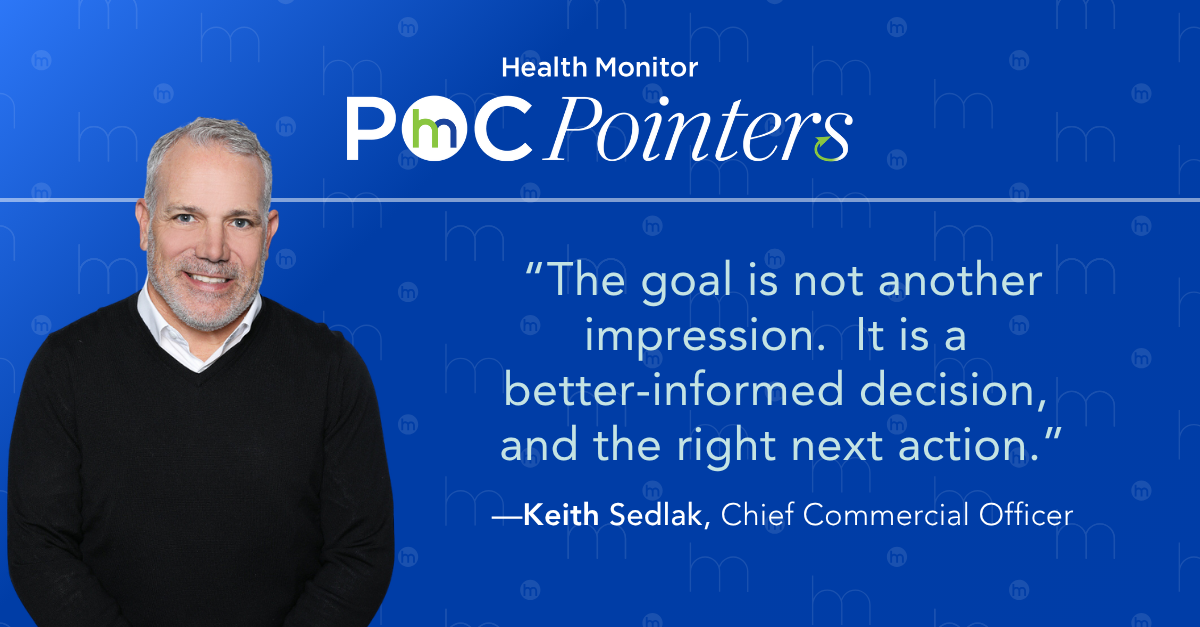
By Keith Sedlak, Chief Commercial Officer, Health Monitor Network
After a week of conversations with pharmaceutical leaders at Fierce Pharma Week in Philadelphia, a consistent theme emerged: Pharma marketing is moving beyond the question of how to reach patients and healthcare professionals (HCPs) across more channels.
The more important question is becoming: What should happen next?
The event emphasized decision-based orchestration, connecting customer intent, behavior and context rather than simply increasing activity across channels. For marketers, the challenge is how to turn greater intelligence into better decisions and, ultimately, more meaningful actions.
From More Touchpoints to Better Moments
For years, pharma marketers have invested in omnichannel strategies designed to reach the right person, with the right message, through the right channel.
That remains important. But it is not enough.
Not every interaction carries the same weight. Some moments in the patient journey have greater potential to turn information into action, and the clinical encounter is one of the most powerful. Research summarized by the Agency for Healthcare Research and Quality (AHRQ) finds that patient decision aids can improve knowledge, increase participation in decisions and strengthen patient-clinician communication.
At the Point of Care, patients are not simply being reached; they are actively engaged in their health, often at a time when HCPs are evaluating treatment options and important decisions are being made. Education, diagnosis, treatment initiation, affordability, adherence and persistence can all intersect.
For marketers thinking about where and how to engage patients and HCPs, that distinction matters. The clinical moment is more than another channel in a media plan. It is where information can become conversation, conversation can become a decision and a decision can become action.
Data Needs a Destination
The expanding role of data, analytics and AI is giving marketers new ways to identify signals, understand audiences and personalize engagement with greater precision. But more intelligence does not automatically translate into greater impact.
We are moving toward a Next Best Action mindset, using available signals to determine the most relevant intervention for a patient or HCP at a particular moment. Fierce Pharma Week programming similarly highlighted the use of real-world signals to decide whom to engage, when and through which channels.
For pharma marketers, the opportunity is not simply to identify that next action. It is to connect intelligence to the moments and environments where that action is most likely to matter. Point of Care has an important role to play when relevant education supports patients and HCPs in a decision-making environment.
Trust Matters More as Technology Accelerates
As AI transforms how quickly information can be created, personalized and delivered, another element of healthcare communication becomes increasingly important: trust.
According to a 2026 KFF poll, 77% of respondents expressed concern about the privacy of personal medical information shared with AI tools.
Context matters. Credibility matters. Environment matters.
That makes the environment surrounding a message an important part of engagement strategy. Technology and data can help determine what information is relevant and when it may be needed, but trusted education can help make that information meaningful.
The Next Evolution of Point of Care
The future of Point of Care will not be defined by any individual format. It will be defined by how effectively marketers connect data, education and action around the clinical moment.
That means understanding where a patient is in their journey, delivering relevant information, supporting productive conversations between patients and HCPs and, increasingly, measuring what happens afterward.
The industry has spent years building the data, technology and infrastructure required to better understand audiences across the healthcare journey. The next opportunity is to put that intelligence to work by identifying the moments with the greatest potential to move people from awareness to action.
Because, ultimately, the goal is not another impression.
It is a better-informed decision—and the right next action.
References
Agency for Healthcare Research and Quality. (n.d.). The SHARE approach—Achieving patient-centered care with shared decisionmaking: A brief for administrators and practice leaders. https://www.ahrq.gov/health-literacy/professional-training/shared-decision/tool/resource-9.html
Fierce Pharma Week. (2026a). Panel: Omnichannel orchestration that improves timing, relevance, and impact [Conference session description]. https://www.fiercepharmaweek.com/event/fierce-pharma-week-2026/session/panel-omnichannel-orchestration-improves-timing-relevance-and
Fierce Pharma Week. (2026b). Panel: Drive omnichannel decisions with real-world diagnostic data and intelligence [Conference session description]. https://www.fiercepharmaweek.com/event/fierce-pharma-week-2026/session/panel-drive-omnichannel-decisions-real-world-signals-and
KFF. (2026). KFF polling on health information and trust. https://www.kff.org/public-opinion/kff-polling-on-health-information-and-trust/
Montero, A., Montalvo, J., III, Kearney, A., Valdes, I., Kirzinger, A., & Hamel, L. (2026, March 25). KFF tracking poll on health information and trust: Use of AI for health information and advice. KFF. https://www.kff.org/public-opinion/kff-tracking-poll-on-health-information-and-trust-use-of-ai-for-health-information-and-advice/
Veeva Systems. (2025, May 29). Veeva Pulse report finds content-driven engagement lags despite proven boost to treatment adoption. https://www.veeva.com/resources/veeva-pulse-report-finds-content-driven-engagement-lags-despite-proven-boost-to-treatment-adoption/
