
How pharma marketers can better engage HCPs with relevant, high-impact content
Watch our full masterclass from the PHM HealthFront below, then explore key takeaways from the discussion.
At the 2026 PHM HealthFront, one question took center stage: In an increasingly crowded landscape, what actually captures an HCP’s attention?
Today’s clinicians face a nonstop flow of updates, ads, emails and social posts—yet only a fraction of that content earns real engagement. Understanding what HCPs find valuable and what they tune out is now essential for any pharma marketer trying to build trust and relevance.
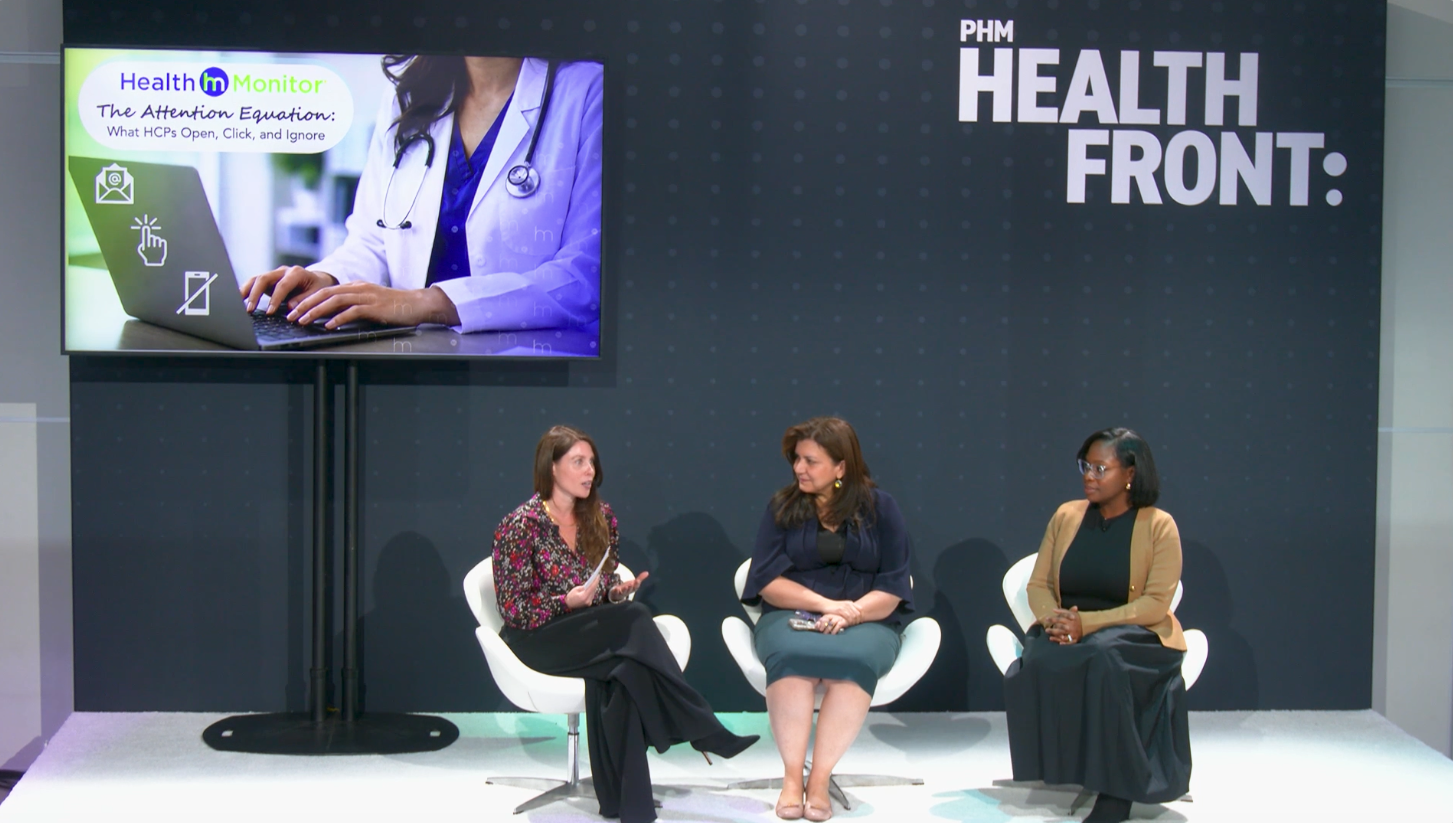
In Health Monitor’s masterclass, The Attention Equation: What HCPs Open, Click & Ignore, Gwen Park, Senior Vice President of Pharma Sales and Marketing at Health Monitor Network, led a discussion with Maryam Lustberg, MD, MPH, Director of the Breast Center at Smilow Cancer Hospital and Chief of Breast Medical Oncology at Yale Cancer Center, and Monique Landrum, Omnichannel & Digital Marketing Lead at UCB.
Together, they unpacked how clinicians consume information today, which channels actually drive engagement and how marketers can better align with the realities of the HCP experience.
Relevance Wins Attention
For Dr. Lustberg, the messaging that breaks through is concise, clinically meaningful, visually clear and easy to absorb. One recent example: A company shared newly published real-world data through a single clean visual—immediately useful, instantly processable.

“The usefulness of the data—and the fact that it was not a busy presentation—is what really caught my attention.”
Maryam Lustberg, MD, MPH,
Chief of Breast Medical Oncology at Yale Cancer Center
The discussion reinforced a broader point: Healthcare professionals are not lacking information. They are lacking time.
Between patient care, meetings, administrative work and ongoing education, clinicians are constantly filtering content. Dense copy and overly promotional messaging get skipped. Information that delivers immediate value gets through.
The Rise of “Snackable” Content
Both speakers emphasized that shorter, easier-to-consume formats are increasingly effective.
Dr. Lustberg noted that many physicians spend time on their phones between patients or meetings—making bite-size information far more practical than long videos or elaborate content experiences.
For marketers, this shift is changing how media is developed and distributed. Landrum said UCB is seeing strong performance from “snackable” formats designed to capture interest quickly and guide HCPs to deeper educational content when appropriate. The goal: the right message, in the right format, at the right time.
Simple infographics, label updates and concise clinical summaries were singled out as formats that consistently resonate.
Social Media Is Becoming a More Credible HCP Channel
The conversation also explored the evolving role of social media in HCP engagement.
Paid social campaigns have performed well for UCB, particularly in newsfeed and story placements. Landrum cited one Meta campaign that generated approximately 50,000 clicks to a website, demonstrating strong HCP engagement within social environments.
Dr. Lustberg added that platforms like LinkedIn have become increasingly relevant for HCPs, while Facebook and Instagram are also seeing meaningful clinician use. Content shared by trusted key opinion leaders (KOLs) tends to be especially well-received. Still, credibility and context matter: LinkedIn’s professional tone and perceived brand safety make it the most reliable of the bunch.
AI Is Reshaping How HCPs Search for Information
A major theme throughout the session was that AI-driven information-seeking is moving fast—and into the point of care. Both speakers said clinicians are turning to AI-powered search to access information in real time, with direct implications for how and when pharma messaging needs to show up.
Landrum pointed to the pace of AI adoption as one of the most consequential shifts ahead for healthcare marketing. Dr. Lustberg echoed that sentiment, anticipating a near-term future of more precise, algorithmically driven messaging built around specific HCP needs and practice patterns.
Context Matters More Than Channel
Omnichannel has multiplied the ways pharma brands can reach HCPs, but reach alone doesn’t move the needle. Engagement depends on context and usefulness far more than channel volume.
Email is the clearest example. Clinicians are inundated, so most messages get skimmed and deleted. But well-crafted newsletters, high-quality educational content and event-related emails can still break through, particularly when they include valuable KOL perspectives or clinically relevant insights.
EHR advertising illustrates the inverse problem. The placement reaches HCPs at the point of care, but Landrum noted some clinicians may perceive those messages as disruptive within the care journey.
The takeaway: Timing, environment and user mindset matter as much as channel selection.
Designing for the HCP Experience
Across the session, one idea remained consistent: The future of HCP engagement depends on understanding how clinicians consume information.
That means:
- Prioritizing concise, actionable messaging
- Designing visually clear content
- Delivering information in moments where HCPs are receptive
- Respecting the realities of clinical workflow and time pressure
- Creating pathways from quick-touch content to deeper educational experiences
This philosophy continues to guide how Health Monitor connects HCPs and patients with trusted, high-quality content at the point of care and beyond.
