
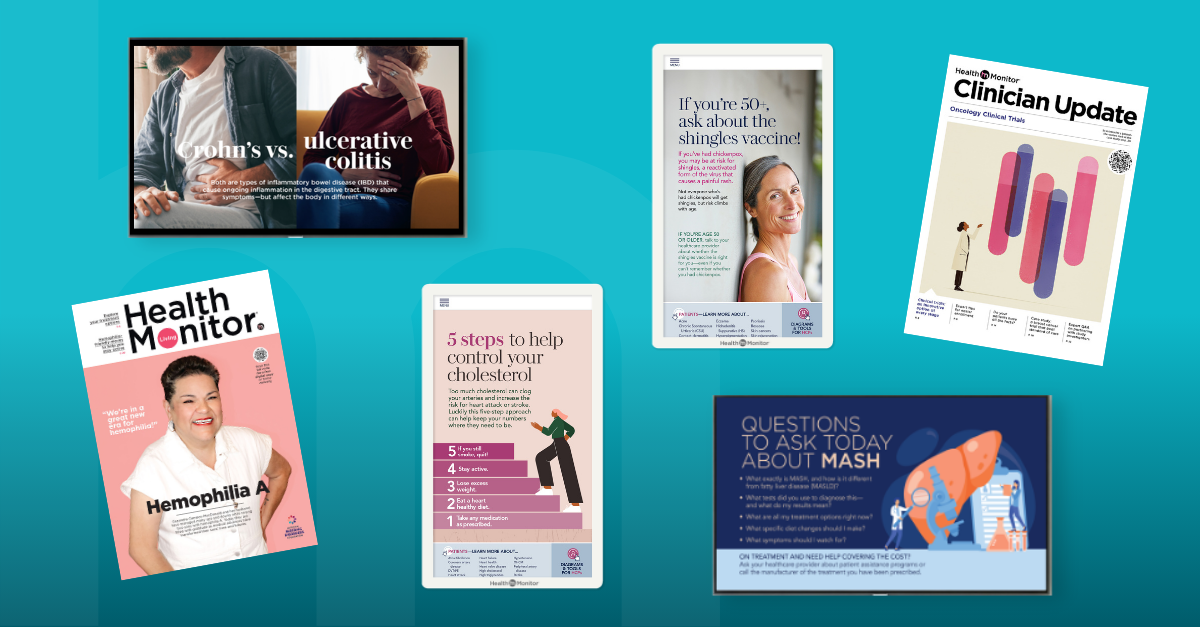
Health content has never been more abundant—or more forgettable. Patients see hundreds of health messages every week, but very few change behavior. Most still arrive at appointments uninformed, leave confused and struggle to follow through on treatment decisions. The problem isn’t a lack of health content. It’s a lack of context—the clinical setting, the condition, the readiness to act.
There is one environment where that changes: the point of care. The brands that understand this are seeing results that no other channel can match.
The Attention Problem General Health Media Can’t Solve
When a patient sits down in a waiting room or an exam room, something shifts. They’re not passively scrolling. They’re already thinking about their health, their symptoms and their next steps. Their attention is focused in a way it almost never is anywhere else.
That context is extraordinarily rare. And extraordinarily valuable.
Yet for years, pharma brands have poured budgets into channels that reach patients everywhere except in that moment: before a diagnosis, outside a clinical context, far from any real decision.
The data reflects the gap. Among patients who saw a prescribing healthcare professional (HCP) in the past year, point of care ranks as the #2 health information source overall—second only to the doctor—and the #1 source for patients under 45. Television, where pharma brands spend billions, ranks 24th out of 36 health information sources.¹
“The biggest misconception we hear from brands is that reach equals impact. It doesn't—not in health. A patient who sees a TV ad for a medication has no frame of reference. A patient who reads about that same medication while waiting to discuss that exact condition with their doctor? That's a completely different conversation.”
Gwen ParkSVP of Pharma Sales & Marketing, Health Monitor Network
Why Condition-Alignment is the Difference-Maker
Not all point of care content is created equal. The variable that most determines whether POC education moves patients to act is condition alignment—the degree to which the content they encounter directly matches the condition they’re being seen for.
Generic health content is often just noise. But when a patient with type 2 diabetes engages with content in the waiting room or exam room—content specifically focused on managing blood sugar, understanding treatment options and preparing for conversations with their HCP, content that was placed in that office because that HCP treats diabetes patients—the dynamic becomes entirely different.
The patient isn’t being advertised to. They’re being educated. The distinction matters enormously to how patients process and retain the information. Research consistently shows that people in a specific medical context, receiving content relevant to their condition, demonstrate stronger understanding and greater motivation to act on it.⁵
Health Monitor’s approach is built around this principle. Every piece of content is developed for a specific condition, medically reviewed by a trusted key opinion leader (KOL), and placed exclusively in the offices of physicians who treat that condition. The content belongs in the room where it’s delivered. The demand for condition-aligned education runs both ways: 64% of physicians say they would provide more support materials and tools if they were more customized to their patients.¹
“Condition-aligned education changes the quality of the conversation inside the exam room. When a patient has already read about their diagnosis, the HCP isn't starting from zero—they're building on a foundation. That's better for the patient, better for the HCP and better for treatment outcomes.”
Lindsay BosslettVP, Editor-in-Chief, Health Monitor Network
The Proof is in the Numbers
When patients engage with condition-specific education at the point of care, they don’t just become more informed. They become more active participants in their own care.
- 83% of HCPs indicate that sponsor content on patient education screens prompts patients to ask about therapy type.²
- 85% of HCPs are actively interacting with patient education screens during appointments.²
- 9 out of 10 HCPs recognized sponsored ads integrated into patient education content.²
- 58% of patients who noticed in-office advertising asked their HCP about the advertised treatment—up 19% since 2022.¹
- 34% of those patients actually received a prescription for a newly advertised drug following that exposure.³
- Patients who noticed ads at an HCP’s office were significantly more likely to fill a prescription or take a medication as prescribed (75%) after seeing a medical professional, compared to those who didn’t notice any ads (61%).¹
These numbers tell a story that no other health media channel can match: POC education doesn’t just create awareness, it creates conversations. And conversations drive prescriptions, adherence and outcomes.
This is also why 9 out of 10 patients say that education at the point of care is important to understanding their health.¹ The patients themselves recognize what the data confirms.
Scale, Trust and a Channel on the Rise
In 2025, the Point of Care industry continued to surpass $1 billion, with an estimated 15% growth from 2024 and revenue in the $1.2 billion range,⁴ as pharma marketers increasingly prioritize precision and measurable outcomes over broad, untargeted reach. The business case for condition-aligned POC education has never been stronger.
The results bear this out. Pharma brands that commit to condition-aligned POC education see measurably stronger patient engagement, and they come back. Health Monitor’s 88% partner renewal rate reflects not just performance, but the kind of trust that clinically credible content builds over time.
91% of patients exposed to POC advertising report that it supports them in becoming more active participants in their own health care.³ That’s not a media metric. That’s a health outcome.
The Takeaway for Pharma Brands and Agencies
The race for patient attention is not going to be won by the brand with the biggest media budget. It’s going to be won by the brand that shows up with the right message, for the right condition, at the exact moment a patient is ready to act.
That moment is the point of care. And the content that wins there is content built for it—condition-aligned, KOL-reviewed, placed with precision and designed to support the conversation between a patient and their physician.
Health Monitor has spent decades building the infrastructure, the editorial credibility and the clinical relationships to deliver that kind of education at scale. The patients are already there. The HCPs are already engaging. The only question is whether your brand is in the room.
References
- M3 MI / POCMA. The Changing Healthcare Landscape and the Rise of Point of Care Marketing (M3 MI’s 2025 MARS Consumer Health Study & 2025 Sources & Interactions + Digital Insights Study). Point of Care Marketing Association, 2025. Report overview:
- Health Monitor Network. Patient Education Screen Engagement Survey, conducted in conjunction with Survey Healthcare Global, April 2022.
- Solomon Partners. Point of Care Report, June 2025. https://solomonpartners.com/wp-content/uploads/2025/08/Solomon-Partners-Point-of-Care-Report-June-2025.pdf
- Point of Care Marketing Association (POCMA). “New Report Reveals Point of Care Marketing Spend Surges 171%.” PR Newswire, April 2025. https://www.prnewswire.com/news-releases/new-report-reveals-point-of-care-marketing-spend-surges-171-as-healthcare-marketing-landscape-transforms-302423737.html Note: This figure exclusively includes revenue from participating Point of Care Marketing Association (POCMA) members. Because POCMA does not represent the entire industry, the actual total industry revenue is likely higher.
- Tatara, N. et al. “Integrated Digital Patient Education at the Bedside for Patients with Chronic Conditions: Observational Study.” JMIR mHealth and uHealth, December 2020. https://mhealth.jmir.org/2020/12/e22947/
